


Installing a landing tread that transitions into carpet flooring is crucial in ensuring your staircase's seamless and professional look. Whether renovating your home or building a new one, a properly installed landing tread can enhance your stairs' aesthetic appeal and functionality.
Our detailed instructions and practical tips will help create a beautiful, durable transition that complements your stair treads and carpeted areas. Read on to learn how to transition wood stairs to carpet landing with expertise, ensuring a flawless blend between your wood stairs and carpet flooring.
Why Install A Transitioning Landing Tread?
Installing a landing tread is essential for creating a seamless and professional look when moving from wood stairs to carpet transition. This transition piece ensures safety, aesthetics, and durability, making it vital for any staircase project.
Safety and Stability
One of the primary reasons for installing a landing tread is to provide a stable and safe transition from carpet to stair treads. Without a proper transition, there can be a noticeable height difference between the carpet and the wood, leading to a tripping hazard. A well-installed landing tread offers a smooth, level surface that reduces the risk of accidents, ensuring that the transition from carpet to wood stairs is safe for everyone in your home.
Aesthetic Appeal
A transitioning landing tread significantly enhances the overall appearance of your staircase. It creates a polished look that seamlessly connects different flooring types. The contrast between the wood's warmth and the carpet's softness can be striking when done correctly. By selecting the suitable wood and finish for your landing tread, you can ensure a visually pleasing carpet to wood stair transition that complements your home's interior design.
Durability and Protection
Carpet edges can fray and wear out over time, especially in high-traffic areas like stairs. A landing tread acts as a protective barrier, preserving the edges of your carpet and preventing them from becoming damaged. This protection is critical to the carpet of the top of wood stairs transition, where the carpet meets the more complex surface of the wood. The landing tread absorbs much of the wear and tear. This in turn can help with extending the life of your carpet and wood stairs.
Easy Maintenance
Maintaining a clean and attractive carpet to wood stairs transition can be challenging. A landing tread simplifies this task by creating a clear boundary between the two flooring types. This boundary makes it easier to clean and maintain each area separately, ensuring that your carpet and wood stairs remain in excellent condition.
Versatility
Landing treads come in various wood species, colors, and finishes, allowing you to transition seamlessly to your upper floor. Irrespective of your preference- traditional, rustic, or modern aesthetic, a landing tread option will enhance your carpet to stair transition.
Tools Needed To Install The Landing Tread
When planning the installation of a landing tread to create a smooth stair to carpet transition, having the right tools is crucial. We have listed the essential tools you will need to transition wood stairs to a carpet landing effectively:
Tools Required for the Installation
- Measuring Tape- Accurate measurements are vital to ensure the landing tread fits perfectly between your wood stairs and carpet.
- Pencil and Ruler- This is necessary to mark precise cut lines on the tread.
- Saw (Miter or Circular)- A saw is essential to cut the landing tread to the correct size. A miter saw is ideal for angled cuts, while a circular saw works well for straight cuts.
- Hammer and Finish Nails- To secure the landing tread in place. Alternatively, a pneumatic nail gun can be used for quicker installation.
- Drill and Screws- For added stability, especially in high-traffic areas, using screws can reinforce the landing tread but will require plugs to cover the screw hole.
- Adhesive (Construction Adhesive)- Applying adhesive helps secure the tread and prevent movement. Remember only to use PL Premium or 100% solvent-based adhesive. Adhesive with any amount of water content can warp solid wood.
- Level- Ensuring the top stair tread transition is perfectly level is essential for safety and appearance.
- Carpet Knife- They are necessary for trimming and adjusting the carpet around the new landing tread.
- Sandpaper or Sander- This smooths any rough edges after cutting the tread.
- Safety Gear- This includes gloves, safety glasses, and a dust mask that will protect you during installation.
Steps To Successfully Install Top Stair Tread Transition
Installing a top stair tread transition between wood stairs and carpet requires careful planning and execution to ensure a seamless and professional finish. Here are the steps to complete this project:
Prepare the Space
Cut the carpet approximately halfway down the top riser, leaving enough to reinstall. Pull back the carpet and remove 4” of carpet padding from the edge of the top stair.
Measure
With a measuring tape, determine the dimensions of the landing area where the wood stair tread will transition to the carpet. Record the width and depth accurately. Mark the landing tread based on your measurements using a pencil and ruler. Ensure you leave enough space for the carpet to tuck in if necessary.
Cut the Landing Tread
Use a miter or circular saw to cut the landing tread to the marked dimensions. Double-check your measurements before cutting to avoid errors. Sand the edges of the cut tread using sandpaper to remove any rough spots and ensure a smooth finish.
Dry Fit the Tread
Position the cut landing tread to ensure it fits perfectly in the designated area. Make any necessary adjustments to the size and shape. Use a level to ensure the tread is flat and even. This step is crucial for both safety and appearance.
Secure the Tread
Apply a bead of construction adhesive to the bottom of the landing tread. This will help to secure it firmly to the subfloor. Carefully place the tread correctly, pressing down to ensure the adhesive spreads evenly. Use a hammer and nails to secure the tread further however, a pneumatic nail gun can speed up the process significantly. Ensure the fasteners are flush with the wood surface.
Transition to Carpet
Cut away excess carpet pad (foam) to clear a space to nail down a tack strip behind the tread. If you do not have a new tack strip, you can use a track strip you removed after pulling up the carpet from your staircase. The tacks should be facing toward the back of the landing tread.
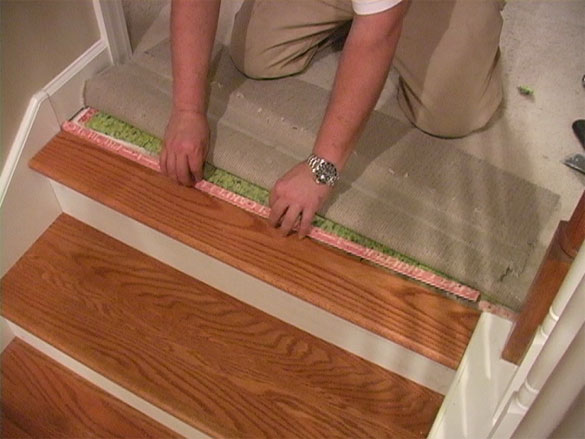
Once the tack strip has been nailed into place, pull carpet over the tack strip. Using a screwdriver (in this case a cat paw is used) and hammer to force carpet over the tack strip ensuring that the carpet grips the tacks.
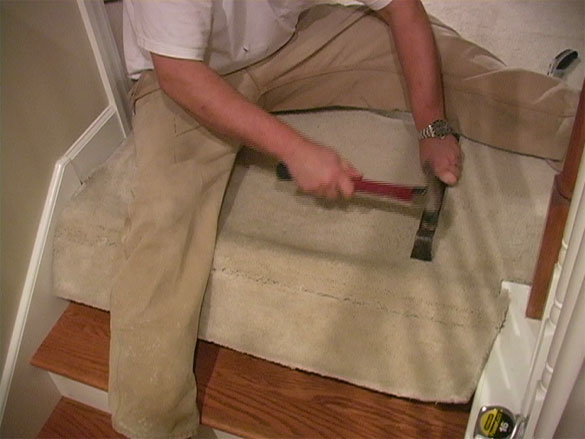
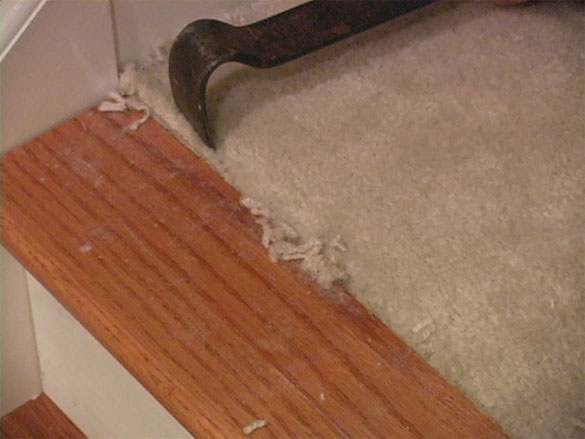
Use a knife to trim the carpet to fit neatly against the new landing tread. Leave enough material to fold up to the tread if needed. Tuck the carpet edge to the tread using a carpet tuck tool or cat’s paw. Ensure the carpet is taut and secure to avoid lumps or loose areas. You can use a staple gun and secure the carpet edge if necessary. Place staples close together to keep the carpet firmly in place.

Final Adjustments
Ensure the landing tread is securely attached and does not move. Apply additional nails if needed. Wipe away any excess adhesive that may have seeped out during installation before it dries. Clean thoroughly to remove any debris. Ensure smooth and even transitions between the wood stair tread and the carpet. Adjust as necessary to achieve a flawless look.
Sealant and Drying Time
If using unfinished wood, apply a wood finish or sealant to the landing tread to protect the wood and enhance its appearance. Allow any adhesive or sealant to dry completely before walking on the new tread to ensure it is fully set and secure.
Wrapping up
Installing a landing tread transitioning into carpet flooring enhances your staircase's aesthetic appeal and functionality. Get a seamless and professional finish by following these detailed steps. For superior stair treads, essential tools, and expert installation solutions, explore the extensive range at Woodstairco.com. Our high-quality products and comprehensive resources ensure you have everything you need for a successful project. Visit Woodstairco.com today to transform your staircase with the best materials and guidance available.





Comments